

History
Smuggling in the Tamar Valley
Smuggling often brings to mind scenes from Poldark — rugged Cornish beaches and hidden coves — or Jamaica Inn on Bodmin Moor, and the Helford River where Daphne du Maurier set her pirate novel Frenchman’s Creek. Yet Landulph and Bere Ferres, on opposite sides of the Tamar, were once smuggling areas too.
In the 18th century, the authorities even stationed a Revenue Cutter in the river off Cargreen to deter smugglers and intercept contraband. [Ed] I believe the pilot cutter was moored up below the confluence for the practical purpose of catching them going up any of the three possible rivers.
At that time, customs duties on imported and exported goods were extremely high — especially on tea, tobacco, wine, spirits, and lace. Many regarded these taxes as unfair, particularly the poor, which led to a flourishing trade in smuggled goods.
In P. E. B. Porter’s Around and About Saltash, written around 1900, he recounts Landulph smuggling tales of goods being landed near Neal Point and hidden close to the rectory, with the parson said to have turned a blind eye.
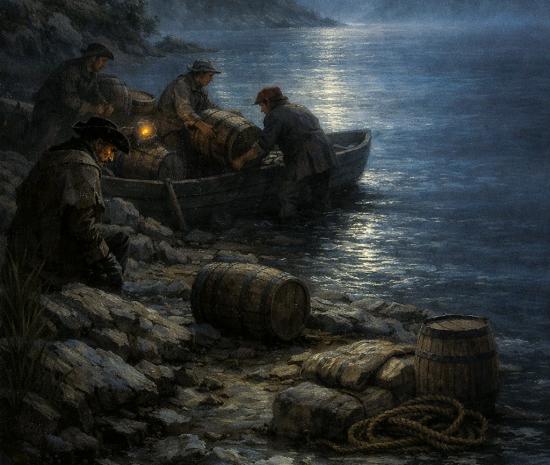
Another story tells of French brandy landed at Landulph and concealed beneath a crop of cabbages in a field near the church. Here, the brandy remained unseen by customs officers searching nearby premises.
When it was considered safe, the kegs were collected by horse and waggon from St Ive and taken to the Sportsman’s Arms at Notter Bridge before being distributed around the local area.

© Andrew Barrett, May 2026, All rights reserved.
The images in this article were generated by AI to illustrate how smuggling might have operated in the Tamar Valley.
This article is protected by copyright - please contact editor@landulph.org.uk if you want to use it.
History of Landulph
- The Legend of Tamara
- Smuggling in the Tamar Valley
- The Medieval Port of Landulph
- Local Mines
- Kingsmill
- St Dilpe and the Celtic Foundation of Landulph Church
- Cornwall For Ever
- The Parish of Landulph
Millennium Project
- Landulph Millennium Photographic Project
- Panel a: Introduction
- Panel b: Church
- Panel c: Chapel
- Panel d: School
- Panel e: Landulph Memorial Hall
- Panel e: Landulph Memorial Hall continued
- Parish Millennium Map
History of Cargreen
Buildings
- History of Landulph Memorial Hall
- History of Landulph Methodist Church
- History of 1914/18 War Memorial Clock