

History
The Crooked Spaniards
A History of the Cargreen Pub
Although much of the history of our “local” has become shrouded in the mists of time, we are very fortunate to have a few members of the Parish who have been able to supply information about the Royal Oak, as it was formerly known.
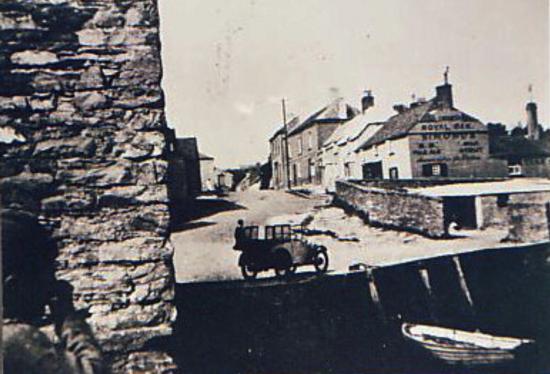
The Sambles
Earliest reference tells us that the property was built in 1590, at which time it was known as The Sambles. Being on the banks of the Tamar, the Inn doubled as a ferry crossing point to the Devon side, and throughout its history, various residents and managers have operated the ferry from Cargreen.
There are records of another inn, the Ring O’ Bells, which was situated further up for Street around the area currently occupied by Fernleigh
Very early information on the Spaniards is sparse, but in the mid 1800’s the innkeeper was Pascoe Prideaux, whose actual occupation is listed as stonemason. He was married to Honor Barrett in 1821, and is buried in Landulph, having died in 1867, age 69.
Tom Spry
At this point, history is again difficult to trace, but local memory recalls that around 1920 the pub was managed by Tom Spry who also acted as the ferryman.
During Tom’s tenancy, it was a regular event for the pub to be visited by numbers of less than genteel people from Devonport coming up the river by boat. As you can imagine, there was a fair amount of trouble from time to time, but Tom had a secret weapon. At the first sign of any trouble, he would send for Herbert Braund, a quite large gentleman by all accounts, who would quickly sort out any problems!
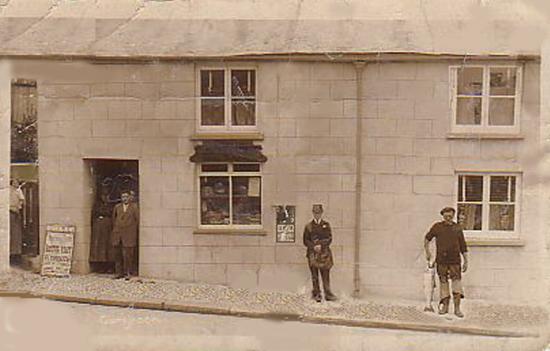
Herb is the one on the right taking home the fish supper. The picture was taken at the top of Fore Street, outside what was then the post office next to Two Rivers, and a cottage formerly called Tavy View.
Strawberry Feast Cruise to Cargreen
In the late 1920`s. Commodore Peck of the Mosquito Sailing Club at Torpoint created a pleasant tradition with the introduction of the Commodore's Strawberry Feast Cruise to Cargreen. Club boats sailed to the Royal Oak where the Commodore paid for everyone's strawberries.
The quay had been previously owned by the Hoskings whose business on the other side of the road included supplying coal to many local properties and a number of schools, and there was a coal shed on the edge of what subsequently became the car park.
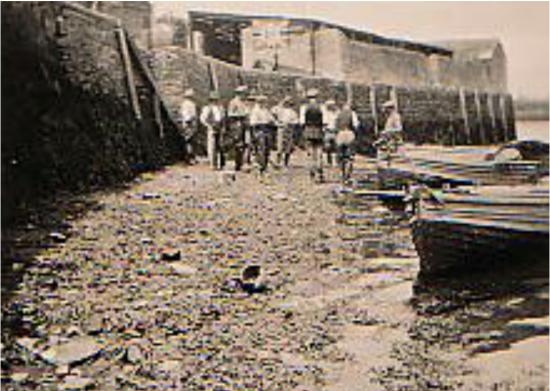
In those days, villagers would cross the river by ferry to Devon, walk up through the fields, and stop the train on the Gunnislake to Plymouth line to travel into Plymouth.
The property was owned by the Simons Brewery, formerly the Tamar Brewery of George Croke, and subsequently part of the Courage group. At this time the inn was called The Royal Oak.
While Tom Spry was manager, Paddle Steamers Empress, Alexander and Hyperion would call at the quay, where landing dues were paid. There is a tale that on one occasion an “unnamed” gentleman became rather merry with drink and passed out, whereupon he was taken to a room and had his entire beard removed. Apparently his children ran into the street next day, claiming that a strange man had been sleeping with their mum!
Tom Spry retired around 1927, and over the following years many of the managers were retired servicemen. Names are recalled as Mr Ryan, Mr Billingshurst, Mr Magner, Mr and Mrs Flay and Mr Johns.
One in particular had a sideline repairing boots and shoes after midday closing. Being based in such a property, it’s hardly surprising just how many people required repairs, but since the local Police Constable also lived in the village everything “must” have been within the law!
World War 2
During World War 2, Mr Cecil Clark had all his teeth taken out in the pub by a dentist who visited Cargreen for this purpose (and his favourite tipple, whisky). Around D Day, villagers can remember American amphibious vehicles, DUKW, or Ducks, coming down Fore Street, and entering the river via Hoskings slipway. There were many service personnel based in the area at that time, and large numbers of service boats moored along the river. Many younger members of the community found their way into the Pub at around the age of eighteen, and entertainment at the time consisted of the Ring Board hung on the wall, shove ha’penny, dominoes and the Landlord’s three daughters! Darts also started to become popular, and it seems that not everybody was too accurate, as just inside the front door in the “locals” bar as it became known, the roof beam to the right, while still intact, is badly chipped from over zealous double top aiming, or rather missing!
On Saturday evenings at 9.30 a plate of cheese would appear, cut into pieces the size of two Oxo cubes, and those present were able to help themselves. This excitement was washed down with half a pint of beer as, at two pence a pint, nobody could afford more. With 240 old pennies to the pound, I guess it wouldn’t take much to end up in the river rather than the road these days. More of that later!
Custom at that time came mainly from the river, and during summer months the place would be packed.
Mr and Mrs Deason
Mr and Mrs Deason, who renamed the pub The Spaniards Inn, arrived in the village the early 1950’s. In addition to their Rolls Royce, they brought along with them Vera Deason’s brother, Tudds Winter, an amiable if rather put upon soul, who looked after the locals bar to the right of the main road entrance, while Vera “ invited “ special customers into the private bar to the left.
During their occupancy of the Pub, poor Tudds was not too well treated, but over the years would quietly get his revenge on his sister whilst appearing to carry out his “duties” in exemplary fashion. One of his habits was to take Tuesdays off, when he would visit friends at the Burton Boys, a Plymouth pub, and he would always bring home his own bottle of Whiskey which was kept under the counter in his locals bar. Any locals visiting Tudds on a Tuesday night in the pub would be sure of a good evening.
The new owners started to modernise with a vengeance, firstly by “barring” the locals which didn’t go down too well. What they had failed to realise was that in other establishments it was actually the locals who attracted the visitors! The customers came, but didn’t stay. If you were to go into Vera’s Long Room, and ask for a pint, you were politely told to go into the other bar since it was not the Lady’s practice to serve beer.
Much of the modernisation included intricate woodwork, since the owner was something of an expert at carving, and several interesting pieces remain in the pub. In particular there was a light switch for the dartboard, where the light would be turned on by pressing a gargoyles tongue. This seems to have disappeared.
Beer pit
Les Clark tells of an oblong pit being opened up during building work. When cleaned out, it was about 2 feet deep, and 4ft by 10 feet, cut to a perfect shape out of solid rock. The understanding is that it was used in part of the process of making beer on the spot, and workmen could fill their jars on the way to work in the mines or on the river. There is also a record of another similar pit found not very far from the pub.
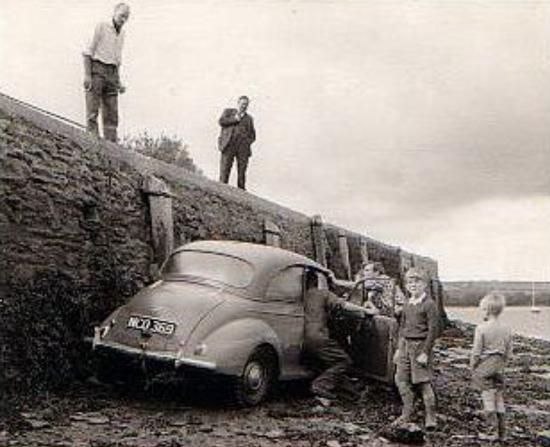
Over the years, many people have asked if any cars ever went over the edge of the quay, and that privilege fell to Vera, who on one occasion, “almost” left the handbrake on in her Morris minor with the result that it finished in the river floating on high tide. The car was subsequently removed, and after repairs was again usable. Fortunately a photograph exists to confirm the fact.
Several people have mentioned the landlady’s virtual inability to reverse her car should she meet anybody coming down the lanes, and it was not unusual for any driver, travelling in either direction to be called upon to move the vehicle.
During Vera’s reign as queen of the pub, the writer can recall Christmas and New Years Eve celebrations when mince pies would be served to the assembled, mainly local, drinkers. Henry Searle would also be asked to perform his Broom dance.
The interior was very different from its present layout, since for a long time ladies had not been allowed into the bar, and they would have had to walk along the footpath by the river to a back entrance where there was a hatch door for serving of “cups of tea or pickled eggs” (?)
Sam Oliver
There was some catering done at the time, but it was the next owner, Sam Oliver in 1976 who started renovation which brought the pub closer to its current layout, and began the refurbishment of the old restaurant at the end of the premises. An immensely affable character, poor Sam was never able to complete the work, and the property suffered quite badly from localised flooding and walls covered in wet patches. The “private” bar was converted to include a pool room, and a long very wet passage down the left hand side of the premises led to the toilets. Eager to help, on one occasion Sam was clearing land which is now the end of the restaurant, when the dumper truck he was driving slipped on plastic sheeting, depositing both itself and its driver in the car park. Have a look next time you’re down there, it’s quite a drop.
Along the river side of the Spaniards, there was a high wall, which Sam removed, and replaced with the low wall and cable railing that exists today. He was also responsible for bringing the accommodation out over the path, creating the cantilevered room above the side entrance, and access to the flat.
Another of Sam’s ideas was the raised outside area, with its granite tables. It was during work on this section that a large engraved block was discovered carrying the wording “B.S.Snell 1837” which is now built into the wall. The flat area with seating was put in, using stone from the old Plymouth Millbay railway station.
Always a gentleman, Sam would address friends and customers alike as “sir”, with the occasional “dear boy” thrown in. Far from necessarily being a servile approach to the art of delivering a tipple, when questioned on the subject by Gideon Barrett, he admitted that since he had no memory for names this method of address would often save embarrassment. One other endearing habit was his insistence on always wearing a tie on Sundays. “It’s just what you do, dear boy!”
Raft Race
Bearing some considerable resemblance to Captain Birds Eye, it was Sam who instituted the Boxing Day raft race, an event which invited all comers to set off from the river up towards Halton Quay, and bring their home made craft back to the Spaniards. Over the years, the most amazing designs appeared, including the back half of a truck which unbelievably floated, and several elaborately designed catamarans and rafts, many made up and modified on the quay just before racing commenced.
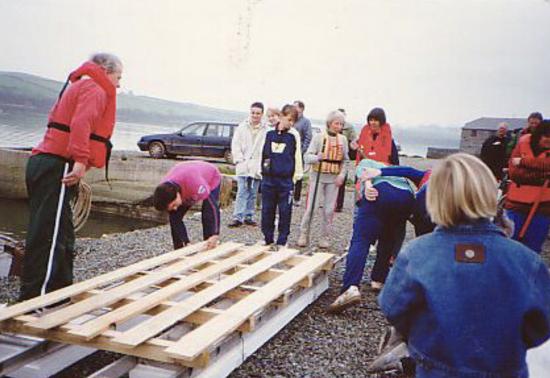
One member of the Parish to join the “sub aqua club” at this time was Gideon Barrett who suddenly disappeared under a very elaborate contraption of plastic drums designed to resemble a pirate raft. Rowing powerfully, his oar removed itself from the rowlock and he went over the front of the vessel, passing under the craft and collecting quantities of seaweed on the way. He was dragged out by one of the crew, his absence causing some considerable consternation as apparently nobody at first realised he had gone for an unplanned swim!
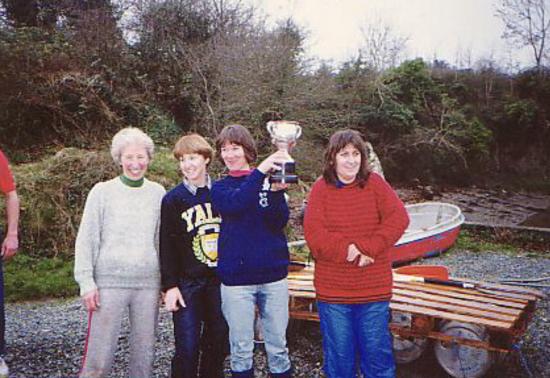
There was of course a cup for the winners, and on one occasion, the Ladies of Landulph triumphed over the rest, largely due to their exemplary skills, but in some part to the assistance of one of the Safety boats preventing another crew from cheating.
Lock - in
Most remote public houses are known for their lock-in`s, and under Sam Oliver’s ownership, the Spaniards was certainly no exception. One story tells of a particular occasion when the darts team was holding something of a “committee meeting” when they were joined by group of revellers on a large keeled boat. The vessel was tied up to the quay, the crew seeming to forget that inevitably the tide would go out. On leaving the pub, all boarded the now somewhat lower boat, and when the ropes were untied, they realised they were actually on the mud, not in the water, the whole thing tipping over, and depositing assorted crew over the side. Undaunted, the sailors called on the help of the darts club, who, tying a rope to a capstan on the ship’s deck, managed to pull it off without moving the boat. Needless to say they then had to wait for the next tide before there was any opportunity to get off the mud. In my research I have heard a number of such stories with a similar subject but slight variation in detail. I am inclined to believe that such events were not uncommon, including the one about the Matelots who moored their Gig to the quay, and emerged from the pub to find the tide gone, and the boat hanging on the wall!
It has to be said that although the Spaniards had seen a good selection of landlords and owners, Sam Oliver, now sadly deceased, is probably the one none of us is likely to forget! During negotiations for the sale of the pub, part of which took place in the locals` bar, Sam was having discussions with the potential purchasers, while Norman Scarffe and Bill Horne were up in the roof space trying to cure a leak. During the negotiations, there was a sudden crack, and the discussion was interrupted by a shower of plaster, and a view of Bill’s rear end hanging through the ceiling.
Hinkley family
In 1980 the property passed into the hands of the Hinkley family who continued the process of turning the pub into a Bar and Restaurant. Completing the renovation of the accommodation, Cecil Hinkley enlisted the help of his son, Martin, who was a chef at the Savoy Hotel in London, to bring the restaurant up to the standard he required.
At Christmas there was normally a lively party atmosphere, and the landlord would allow many local customers to bring their children who would stay safely in the accommodation upstairs while their parents partied down in the bar.
Many young village members, including two of my own children, got their first taste of work in the bars and restaurant during the Hinkley family’s ownership. Cecil and Pat left around 1990, and the Spaniards was run for a time by a business group, latterly managed on their behalf by Terry Haines.
Crooked Spaniards
The major renovation of the pub took place following purchase by the Arnold family, who, having another property at Stoketon, the Crooked Inn, renamed the Pub the Crooked Spaniards, as it is known today.The old rather wet premises had a huge makeover inside, although much of the elaborate woodcarving in the locals bar was retained, and the Quay which had been collapsing into the river for some years was completely rebuilt to form the current car park.
Although records exist for most licensed premises, there is really no substitute for local knowledge, and I should like to particularly thank Mary Eastment, Les Clark, Reg Hosking, Gideon Barrett and Bill Horne for their memories. Their input has been invaluable in the writing of this article as has the extensive research undertaken by Reg Rice.I am also grateful to all those other people who took time to tell me their memories.
© David Hall, 2019, All rights reserved
This article is protected by copyright - please contact editor@landulph.org.uk if you want to use it.
History of Landulph
- The Legend of Tamara
- Smuggling in the Tamar Valley
- The Medieval Port of Landulph
- Local Mines
- Kingsmill
- St Dilpe and the Celtic Foundation of Landulph Church
- Cornwall For Ever
- The Parish of Landulph
Millennium Project
- Landulph Millennium Photographic Project
- Panel a: Introduction
- Panel b: Church
- Panel c: Chapel
- Panel d: School
- Panel e: Landulph Memorial Hall
- Panel e: Landulph Memorial Hall continued
- Parish Millennium Map
History of Cargreen
Buildings
- History of Landulph Memorial Hall
- History of Landulph Methodist Church
- History of 1914/18 War Memorial Clock