Landscape
Landulph Orchard Green
Landulph Orchard Green, near Landulph Church, consists of two fields which the Duchy has provided for Landulph to use as green spaces. These fields have been developed into havens for nature and people using grants from the Tamar Valley National Landscape, Farming in Protected Landscapes and Levelling Up.
For detail, see the chapter on Landulph Orchard Green
The Rainforests of Landulph
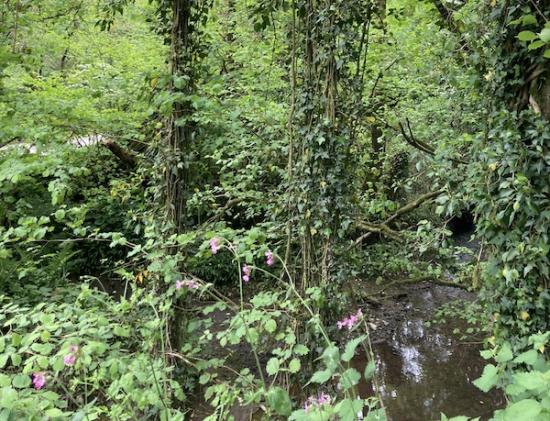
Steep, deep green and secret – that’s how temperate rainforests are imagined. Landulph is lucky: ours are easy to find and easily accessible. Landulph has all the ingredients needed for a rainforest to flourish; a warm south-westerly prevailing wind keeps our temperatures comparatively high throughout the year. We have a notoriously high rainfall, keeping our multitude of springs running through most of the year. You can find seepage from those springs almost everywhere from the high ground down towards the watercourses. Those watercourses have cut deep hollows into the ground and if the greenery in those hollows has remained untamed for a long time, there’s the chance for a rainforest to grow.
Here in Landulph, we have several forests, all slightly different (that’s `forest’ in the old sense of `wild place’ rather than of acres of serried commercial conifers). In this account I focus on three widely varying sites, all of them easy to get to and inspect.
The smallest is in the hollow lane ascending from the Coombe towards Salter Mill. Clearly a steep hill cut down to help horses over the brow, the sides are near vertical, the west rough rock and soil and cloaked with thick moss. Pennywort, small ferns and other tiny plants grow here, courtesy of the water and nutrients dripping down the sphagnum-like moss.
The second and most unusual is on the Tamar foreshore. You’ll find it as you head South from the playing field towards Neal Point. It stretches for no more than a couple of hundred yards, so there’s no need for wellies; just aim for the last of any ebb tide. The tides have undercut the cliff along here. Water runs down much of the face from the fields above, in rivulets or in steady drips. Strands of ivy and bramble hang down in mid-air and there are patches of algae (these plant-names are approximate: I’m not a botanist!) in orange, sulphurous yellow and a harsh green. Best of all for me was finding a patch of what looked like minuscule watercress, close-growing and with perfect leaves the size of a pin-head. I didn’t taste it, nor did I try the water, clear though it looked. The air in this close space is stuffy and a degree or two warmer than elsewhere. It can be creepy.
Tamara Coast to Coast Way
A new long distance path opened in July 2023 – it follows the Tamar from Plymouth to its source and then onto the Cornish-Devon north coast border. The route is 87 miles long and is divided into 7 stages using some existing paths on both the Cornish and Devon banks. One of the challenges for the designers of this path have been the limited crossing points in the lower reaches of the Tamar. At Calstock the main route crosses from Devon to Cornwall using the train! (But this has now been replaced by a foot ferry).
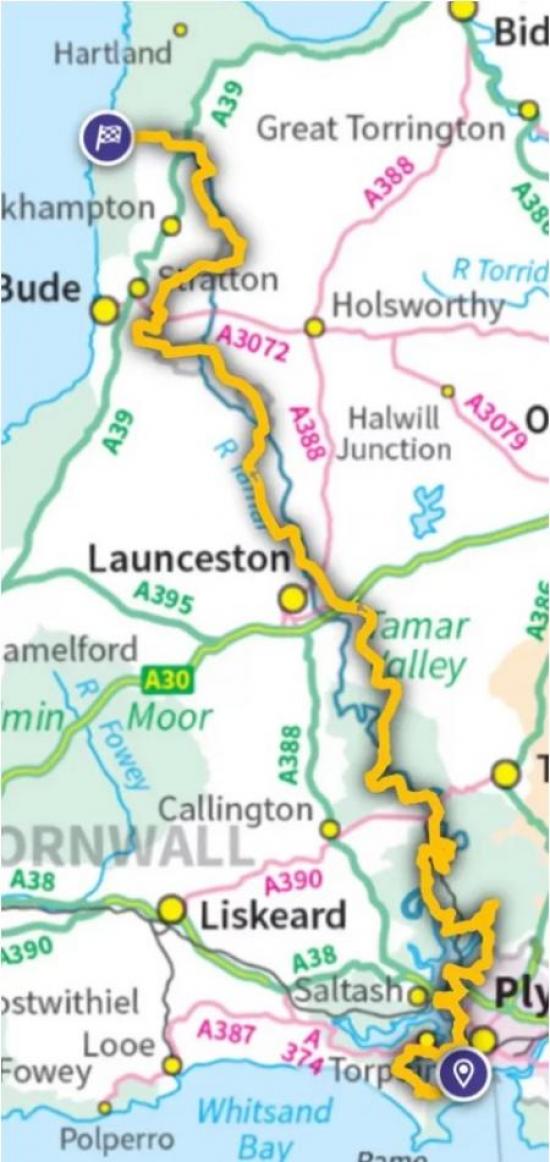
Tamar Valley NL website and the Tamara Way
Lower Marsh Farm
Previously a daffodil farm (of Dan and Peter du Plessis renown), since being sold by the Duchy in the early ‘90’s Lower Marsh Farm has been through a few owners. We moved here just over a decade ago now, and live at the farm with our two children. We moved when our eldest was not even a toddler (he is now taller and stronger than me!) for a childhood more akin to mine growing up on a mountain farm in North Wales.
Ponds make me Happy
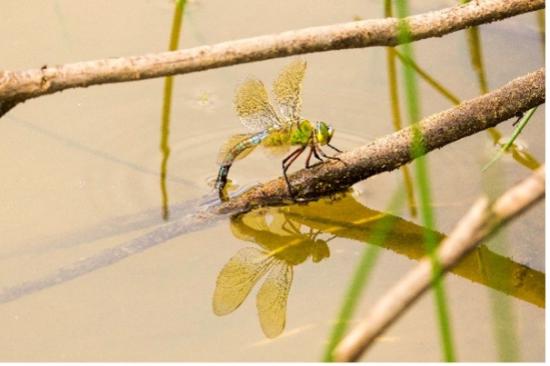
I can identify with the dragonfly. We require water to drink, food to eat and a place to rest and be secure. Looking around our garden, I see very few dragonflies because it offers none of the above. It needs a body of water with some plants in it. Kidney-shaped or round, deep or shallow, wild or formal; anything will attract beetles, newts, tadpoles and dragonflies. A forever changing landscape to sit and watch whilst drinking a cup of tea.