

History
The Medieval Port of Landulph
Today the area between Neal Point and Parson's Quay seems very tranquil except for the distant rumble of traffic on the Tamar Bridge. But in the 15th Century this area could have been a hive of activity, as Landulph was a port and a departure place for pilgrims.
The Manor of Landulph came into the possession of the Courtenay Family- Earls of Devon in the 14th Century and Edward Courtenay is thought to have developed Landulph as a port before his death in 1419.
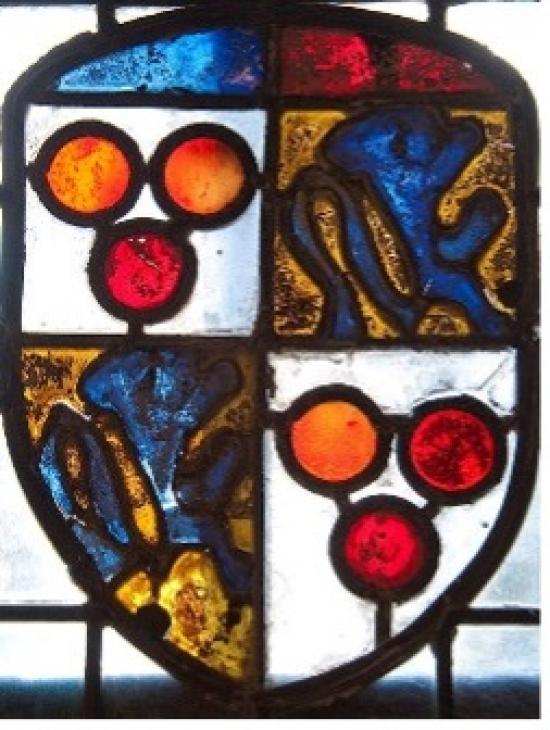
The Arms of Courtenay displayed in stained glass in Landulph Church. The Courtenay family were lords of the Manor of Landulph and Patrons of the Church until 1538 when Henry VII had Henry Courtenay Marquis of Exeter executed on a trumped-up charge of treason and the Manor of Landulph was given to the Duchy of Cornwall.
Landulph is first recorded as a port supplying ships to transport troops in the war against France in 1417 and there are records of a least another five being supplied between 1432 and 1452, with the largest being 120 tons. To put this into perspective with the other Cornish Ports of the time. Fowey provided 19 ships, Saltash 6, Landulph and Looe 5 each, Penzance 4, Falmouth, Marazion, Penryn and Truro 2 each and Mevagissy 1.
In Northern Spain the shrine of St James in the Cathedral of Santiago de Compostela had become famous as the home of the remains of the apostle James. It was one of the most famous pilgrimage centres of the Middle Ages along with Rome and Jerusalem.
Ships full of Pilgrims departed from Landulph, such as the Mary of Landhelp which left in 1434 with 60 Pilgrims on board.
Landulph Church is thought to have been rebuilt and enlarged around 1420, which corresponds with the development of the port and the need for a larger church for the pilgrims to pray and worship in before they set off on their arduous journey.
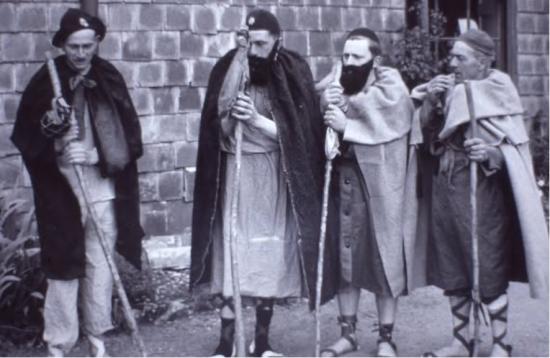
A photo taken from the Landulph Through the Ages Pageant of 1951 when the Pilgrims were played by Dan du Plessis, Bill Evans, Jack and Bill Cloake.
The last mention of a ship from the port of Landulph was the Julian in 1479, after which the port must have declined.
The late Rev Adams, Rector of Landulph between 1930 and 1961 was a very keen historian and tried to work out exactly where the port would have been and thought that Black Rock and Parson’s Quay near Neal Point could have been possibilities.
© Andrew Barrett, April 2026, All rights reserved
This article is protected by copyright - please contact editor@landulph.org.uk if you want to use it.
History of Landulph
- The Legend of Tamara
- Smuggling in the Tamar Valley
- The Medieval Port of Landulph
- Local Mines
- Kingsmill
- St Dilpe and the Celtic Foundation of Landulph Church
- Cornwall For Ever
- The Parish of Landulph
Millennium Project
- Landulph Millennium Photographic Project
- Panel a: Introduction
- Panel b: Church
- Panel c: Chapel
- Panel d: School
- Panel e: Landulph Memorial Hall
- Panel e: Landulph Memorial Hall continued
- Parish Millennium Map
History of Cargreen
Buildings
- History of Landulph Memorial Hall
- History of Landulph Methodist Church
- History of 1914/18 War Memorial Clock